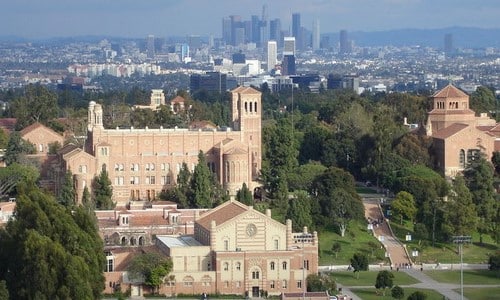
More than 15,400 undergraduate and graduate students from around the world call UM home during the academic semesters. The University has grown from its main location in the City of Coral Gables to include the medical campus located in Downtown Miami, the Rosenstiel School of Marine and Atmospheric Science on Virginia Key, the John J. Koubek Center in Little Havana, the James L. Knight Center in Downtown Miami, and the South and Richmond campuses in southwest Miami-Dade county. With more than 10,800 full- and part-time faculty and staff, UM is the second largest private employer in Miami-Dade County. The University was chartered in 1925 by a group of citizens who felt an institution of higher learning was needed for the development of their young and growing community. The inaugural class of 560 students enrolled in fall of 1926.
One of the Nation's Leading Research Universities
The University of Miami is a vibrant community of exceptionally talented individuals engaged in the pursuit of academic excellence, the discovery of new knowledge, and service to the region and beyond.
The University of Miami was chartered in 1925 by a group of citizens who felt an institution of higher learning was needed for the development of their young and growing community. The South Florida land boom was at its peak, resources appeared ample, optimism flowed, and expectations were high. Supporters of the institution believed that the community offered unique opportunities to develop inter-American studies, to further creative work in the arts and letters, and to conduct teaching and research programs in tropical studies.
By the fall of 1926, when the first class of 560 students enrolled at the University of Miami, the land boom had collapsed, and hopes for a speedy recovery were dashed by a major hurricane. In the next 15 years the University barely kept afloat. The collapse in South Florida was a mere prelude to a national economic depression. Such were the beginnings of what has since become one of the nation's most distinguished private universities.
The University survived primarily due to the vision and persistence of its first president, Dr. Bowman F. Ashe (1926-52). Under his administration, the institution overcame bankruptcy, a reorganization, a world war, and then in the post-war years, experienced tremendous growth and expansion.
When the University opened in 1926, it consisted of the College of Liberal Arts, the School of Music, and the Evening Division. During the Ashe presidency, the University added the School of Law (1928), the School of Business Administration (1929), the School of Education (1929), the Graduate School (1941), the Marine Laboratory (1942; presently the Rosenstiel School of Marine and Atmospheric Science), the School of Engineering (1947), and the School of Medicine (1952).
Dr. Jay F. W. Pearson assumed the presidency in 1953. A marine biologist by training, charter faculty member, and an assistant to President Ashe since 1929, Dr. Pearson presided during a decade of unprecedented growth. Total enrollment stood at over 10,000 in 1953 and increased to nearly 14,000 by the end of the Pearson presidency in 1962. New facilities and resources were added to keep pace with student enrollment as well as to increase the research strength of the institution. The University also added an undergraduate honors program, expanded the graduate programs to the doctoral level in a dozen fields, established a core curriculum for undergraduates, and vastly increased its research activity.
The University entered a new epoch, a time of reexamination and consolidation under its third president, Dr. Henry King Stanford (1962-81). Stanford's presidency was marked by further emphasis on research activity, additions to physical facilities, and reorganization of the University's administrative structure. Several research centers and institutes were established, including the Center for Advanced International Studies (1964; presently the Graduate School of International Studies), the Institute of Molecular and Cellular Evolution (1964), the Center for Theoretical Studies (1965), and the Institute for the Study of Aging (1975).
In 1981, Edward T. Foote II became its fourth president. Under his leadership, the University was elected to membership in Phi Beta Kappa, the nation's oldest and most prestigious honor society; three new schools were created--Architecture, Communication, and the Graduate School of International Studies along with its research component, the North-South Center; average SAT scores of incoming freshmen increased by nearly 100 points; and the University began and completed a series of renovations that converted standard student dormitories into a system of residential colleges.
In addition, Foote was the catalyst behind the creation of the University's strategic plan, a blueprint for the acceleration of the University's excellence. A five-year $400 million Campaign for the University of Miami, launched in 1984, surpassed its goal in April 1988 and ended with a $517.5 million commitment.
The University entered its present phase in 2001 when Donna E. Shalala became its fifth president. President Shalala was the longest serving Secretary of Health and Human Services in U.S. history. She served in the Clinton Administration from 1993-2000 and oversaw a $600 billion budget. Prior to that, she was Chancellor of the University of Wisconsin – Madison for six years, the first woman ever to head a Big Ten University. President Shalala also served as president of Hunter College, The City University of New York, for seven years.
On October 16, 2003, the University announced Momentum: The Campaign for the University of Miami, the most far-reaching and ambitious comprehensive campaign in its history. The historic fundraising drive surpassed its $1 billion goal in January 2006, a year and a half ahead of schedule, and the University established a new goal to raise an additional $250 million by the end of 2007.
The University of Miami, a private, non-sectarian institution, currently enrolls 15,670 students in approximately 120 undergraduate, 108 master’s, 49 doctoral, and two professional areas of study. The University’s students represent all 50 states and 114 foreign countries. UM alumni live in all 50 states and in 148 countries. There are more than 155,000 alumni in the University’s history.
The University of Miami (also known as Miami of Florida, UM, or just The U) is a private, non-sectarian university founded in 1925 in the city of Coral Gables in suburban Miami, Florida, in the United States.
The university currently enrolls 15,449 students in approximately 115 undergraduate, 114 master’s, 51 doctoral, and two professional areas of study. The University’s students represent all 50 states and 148 foreign countries. There are currently 2,348 full-time faculty members whose ranks include Guggenheim fellows, Fulbright Scholars and National Science Foundation recipients. Of this distinguished faculty, 97% hold doctorates or terminal degrees in their field. With more than 10,800 full and part-time faculty and staff, UM is the second largest private employer in Miami-Dade County.
The University of Miami is accredited by the Southern Association of Colleges and Schools and 23 additional professional and educational accrediting agencies. UM is a member of the American Association of University Women, the American Council on Education, the American Council of Learned Societies, the Association of American Colleges, the Florida Association of Colleges and Universities, and the National Association of Independent Colleges and Universities.
"Momentum: The Campaign for the University of Miami" was a fundraising effort launched in 2003 with the goal of raising $1 billion dollars to improve facilities, recruit world-renowned faculty and expand the number of endowed student scholarships.
At the close of the campaign, UM became the youngest university in the nation and the first in Florida to reach the billion dollar mark, raising $1.4 billion as of February 2008. Of the 56 universities that have run billion dollar campaigns, UM is the only private institution and one of only four established in the 20th Century to achieve this milestone.
The University of Miami was chartered in 1925 by a group of citizens who felt an institution of higher learning was needed for the development of their young and growing community. The South Florida land boom was at its peak, resources appeared ample, optimism flowed, and expectations were high. Supporters of the institution believed that the community offered unique opportunities to develop inter-American studies, to further creative work in the arts and letters, and to conduct teaching and research programs in tropical studies.
|
Full-Time vs. Part-Time
|
Men vs. Women
|
||||
|
Race/Ethnicity
|
|
In State vs. Out-of-State
|
Top States for Incoming Freshman
|
| Percent of Students International: | 8% |
| On-Campus Housing Available: | Yes |
| Percent of Students Living On-Campus: | 29% |
| Freshman Students Required to Live on Campus: | Yes |
| Member of: | NAA, NCAA |
| Sports Include: |
Football (Atlantic Coast Conference) Basketball (Atlantic Coast Conference) Baseball (Atlantic Coast Conference) Track (Atlantic Coast Conference) |
| Tuition & Fees (undergraduate) | Expenses | ||
Published Tuition and Fees: |
$ 29,504 | ||
Average Tuition for Full-Time Undergrads: |
$ 29,020 | ||
Required Fees for Full-Time Undergrads: |
$ 484 | ||
| Financial Aid | Avg. Amount Received | % of Students Receiving Aid | |
Federal Grants: |
$ 2,532 | 23% | |
State and Local Grants: |
$ 5,089 | 48% | |
Institutional Grants: |
$ 14,995 | 74% | |
Student Loans: |
$ 6,623 | 48% | |
Any Aid: |
87% |
| Acceptance Rate: | 46% (Highly Selective) |
| Test Scores | |
| SAT Scores: | |
| % of Students Submitting SAT Scores: | 78% |
| Bottom 25th Percentile: | Verbal: 570, Math: 590 |
| Top 75th Percentile: | Verbal: 670, Math: 690 |
| ACT Scores: | |
| % of Students Submitting ACT Scores: | 20% |
| Bottom 25th Percentile: | Composite: 26, Verbal: 25, Math: 24 |
| Top 75th Percentile: | Composite: 30, Verbal: 31, Math: 30 |
| Application Fee: | $ 55.00 |
| Formal Demonstration of Competencies: | Not Required |
| High School Diploma or Equivalent: | Recommended |
| High School GPA: | Required |
| High School Rank: | Required |
| High School Record: | Required |
| Recommendations: | Required |
| TOEFL: | Required |
| Test Scores: | Required |
College Advice |
|
Question:
University of Miami or CU?
I have been accepted to the University of Miami and University of Colorado at Boulder. I don't know what to choose! Both schools have excellent chemistry departments (my major is biochemistry) and both offer everything I could imagine!! What would you choose?!
10 months ago
Best Answer
First of all, congratulations! If you think the schools are pretty similar in terms of the course offerings, etc. Then start looking at your lifestyle at these schools. Miami and Boulder are two very different cities, so start taking your every day life into account. Do you like the snow? Do you like the heat? The beach? What is campus life like? Are there organizations on campus or nearby you can join? Cost of living? I know a friend that dropped out of school in Washington because he just couldn't take the rainy weather any more!
So take these sorts of things into account to help you make your decision.
|
|
I am currently in 10th grade and taking pre-ib. I want to go to the university of miami and i just wanted to know if all the work that i'm doing now and will especially be doing in 11th and 12th grade be worth it. I want to be prepared for college, but i also only have 3 more years to be with some of the people i may never see again and i want to enjoy this. So if someone who already took the class could just let me know that they did the work and were successful and still got to hang out with their friends and enjoy themselves, i would feel a lot better instead of being semi-depressesed right now. If it helps I'm in the IB program @ miramar high so if any of you miramar IB students are out there please help me!
16 months ago
Best Answer
No college requires that you take the IB. Miami is relatively competitive for admission, so it would certainly help if you take the most challenging courses in your school, but if you do extremely well the next level down, you'll probably still get in. But try it, and if you don't do well, or feel overstressed move to easier classes.
|
|
Question:
how good is the university of miami?
i keep getting all sorts of stuff from the university of miami, and i dont even know what their majors are. or what they focus on. do they have a good business section? how hard is it to get in? they want me to send some applications and stuff, should i? i am a white male living in texas. i know that white males are less apt to get into a college over a female from another race. how hard would it be to get in? what all do they cover?
thanks!
yeah, im talkin about the one in florida. is there really a miami in ohio? lol thats funny
16 months ago
Best Answer
they have a ton of majors to choose from. they also have a great business section. and on top of that, their avg. student/teacher ratio is like 18:1. thats really good. i would go for it. just send some applications in and see what happens. if your grades are good enough, it wont really matter what sex and race you are, or where you are from. it is a major university, so it wont be exactlly easy to get in, but definately doable. they have like 15,000 students, so it cant be too hard. lol
well, good luck
hope this helps.
|
|
i know it is a party school but are the party's mainly in frats or clubs?? and are the frat parties any good?
florida, the one in ohio is called miami university
17 months ago
Best Answer
Im going to the University of Miami, in Coral Gables...
And it isn't a go greek or go home school. I'm actually considering joining one... but it is 10 - 13 percent of the school is greek.
And yes... it is a big party school, lots to always do... You are in one of the most diverse cities... there is always something to do.
Some of the fraternity parties are good, and sometimes some aren't... just depends on a lot of factors.
[juun_yukiko < I don't think anyone cares that you took it off your list of schools... it is actually a very hard school to get in. Preety selective. Example 600 out of 4,000 + for transfer students were picked... plus it's tough to live where people spring break : ) ]
And most people don't know it's a private school not PUBLIC
|
|
I am an international student with a GPA 4.10 out of 5.0.My math SAT is 730 but verbal is 480.Toefl is 600.I am an IB student but want to become a non IB in my senior year.Would this be a disadvantage for me in the admissions process?
18 months ago
Best Answer
I thought the University of Miami was one of the easier schools to get into. NYU is a bit tougher and I don't know what score range the Toefl is, if you're fluent in english that's all that matters.
non IB senior year probably won't make a difference.
I could be wrong about Miami, I might be basing it on their football team, but I'm pretty sure that whole school is a bunch of thugs.
|
|
I have never been to miami, I don't know the area or the people..but it seems like a great school to transfer from since I dislike being in my hometown of philly. They don't even have on campus housing and that makes me feel like I won't feel welcomed to miami if I'm living on my own near the campus. Is it worth it?
18 months ago
Best Answer
Hello first off University of Miami, does have on campus housing, and people do live on campus. Secondly, the area has its good and bad spots but since you will be on campus I am sure everything will be okay..but make sure know about an area before you decide to go venturing. Third, the school it self is expensive for most, and fairly hard to get in, you are very lucky to get in there girl! You can go to www.collegeboard.com and go to find a college and click college search there you can see a whole lot of information about University of Miami that you may not get from there own website! Good Luck and if you believe in God, God Bless!
|
|
Will be moving from Michigan to South Florida to attend University of Miami in Fall 2008. Have never lived there before and want some advice on the school and living in Miami in general.
19 months ago
Best Answer
I'm an undergraduate at UM, so I can help only a little since I live directly on campus. First of all, your experience will probably depend on what your concentration in. Miami has an amazing and friendly music department, so if you are getting your Ph.D in music (choral???), you are going to have a blast. I'm sure that many other departments are fun too. Miami has a great educational reputation, and I'm told that the graduate programs are just as prestegious.
Miami itself is quite different from Michigan. Multiculturalism is everywhere, so if you are not used to hearing and seeing people who do not originate from the Midwest, you might have to do some adjusting. Not only do we have lots of Hispanics and Latinos, we also have a large amount of Jewish and Creole people, so it really is a lot of fun. The supermarket is really fun just because of all the ethnic food!!
Driving in Miami is terrible. Miami was recently named the worst city in the US for road rage, and that really is not joking. People, quite honestly, run red lights, do not stop at stop signs, speed up when they see someone trying to change lanes, go as quickly as they can no matter the speed limit, and do any other conceivable traffic no-no. Someone once deliberately slammed her brakes in front of me to try to get me to hit her. The only consolation is that most of the cars driven in Miami are sparkly and beautiful, so it is almost like driving the real version of some video game. I hope for your sake that you live very close to the university because "rush hour traffic", ie the time from sunrise to two hours after sunset, is extremely horrible.
Miami is hot. You will not see stars at night because of the light pollution. Hurricanes are regular occurances. Macaws wheel in the air in flocks. Fit, tanned, and beautiful people are an everyday sight. All-in-all, it is quite an amazing experience that I would recommend at least once.
|
|
19 months ago
Best Answer
Any medical school is a good medical school!
But if you mean, is Miami a good place to prepare as an undergraduate for application to med school, the answer is, not bad but not one of the top choices.
Admission to med school is really tough, so you should go to the toughest school you can get into... one of the Ivies, Duke, Chicago, Stanford, Emory, etc. Those schools do a great job of preparing all their students for medical school, and have a good record for getting the kids into med school.
At large second-level universities, they have so many students that there is not the same kind of personal attention. You have to be more of a self-starter and self-motivator to stand out from the crowd of premeds. There is more competition because everyone knows that only a few are going to be accepted at med school.
|
|
what the rank of both of them? can anyone tell anything about it
20 months ago
Best Answer
University of Miami:
In the 2006-07 issue of U.S. News & World Report's "America's Best Colleges", the University of Miami is ranked 54th among 254 "National Universities".[5] UM is also one of 146 colleges named a "Best Southeastern College" by the The Princeton Review in its most recent 2006 edition.[6]
Florida International University:
FIU is ranked among the top 100 public national universities in the U.S. News & World Report annual guide to "America's Best Colleges." FIU was the youngest institution in that group. U.S. News & World Report's "America's Best Colleges" (2006 and 2007) also ranks FIU's undergraduate international business programs 7th best in the nation and lists the Chapman Graduate School of Business among the top 20 business schools in the U.S. for excellence in international business.
Good Luck.....
|
|
22 months ago
Best Answer
yes, It is always warm and there are some of the best looking people. Beyond that there are all great students besides the athletic scholars. It is expensive so if you get accepted the fsu or u of florida go there.
|
|
Being honest here, I struggled with pre-cal/business calculus so my gpa ended up at a 2.8
However i'm a student at Baylor university, do you think having 52 hours from a top national university would offset my average GPA and possibly* allow a shot at getting in to Miami for business.
Just curious
23 months ago
Best Answer
generally transfer requirements are much less restrictive than if you were applying as an undergrad...you can also take classes as an unmatriculated student while establishing residency in the state...
|
|
Also if I attend I know its in the suburbs but is it easy to get around so I can go shopping, eat or get to the airport?
24 months ago
Best Answer
the school, first off is in a great location. Since it is in the suburbs, it's a very safe neighborhood (one of the few places in Miami where people actually walk the streets safely), and just around 10 minutes away is Sunset Place which is filled with shops and restaurants that can range from the $ to the $$$$. But even if you don't want to walk that far, there are even shops almost directly behind the school. Academically, UM is ranked I think 54th in the nation by US News, and it's BS/MD program is a pioneer and one of the best in the nation. If you're still iffy on it though, check out their honors program, the requirements (31 ACT for example) are higher than Ivy League admission (29-33 ACT is usually middle 50%).
As for the airport, Mapquest it!
|
|
These are my three main choices for universities. I don't live in Florida, but love the state. What are the campuses like? Are you enjoying your experiences at this school?
Any other feedback would be great.
I'm planning to study either psychology or psychiatry. If you are studying either of these please elaborate and classes: difficulty, subject matter, jobs wanted, etc.
28 months ago
Best Answer
Of the three, UM has the better academic reputation, but Florida State is not far behind. But of course, UM is private (and an expensive private at that, "Club UM").
Of the campuses UM is again the nicest. FSU is in Tallahassee which offers little beyond the usual college town (taking into account your major).
USF will probably feel like a commuter campus, it's by and large mostly Tampa Bay residents and a number of satellite campuses. I don't know about your major specifically, but I have known people to attend all three, and USF would definitely offer the lightest course-work. Honestly, I would pick UCF or FIU before USF - based on campus, location, and academics.
|
|
Im sure some of you out there have or attend the university of miami. well im curious on how you got in (what was ur GPA, sat scores... ect) plzz help me out in still a sophmore in high school but i wanna get ready so plzz help me out
29 months ago
Best Answer
I can't tell you about the individual requirements for a school, but which University of Miami? I'm assuming Florida...
When I was in admissions, requirements for incoming freshmen included 4 years of English, Biology, Chemistry and another science, Algebra I and II and Geometry, US History and World History, and probably some others, but my brain isn't working totally and I've been out of admissions for a bit. There was also a minimum GPA and ACT score.
Go to the website and check out Office of Admissions - bet you can even email someone there. Keep grades up, take the SAT early so you can practice, if you need to. That's all I can offer right now.
|