| Location: | Southeast |
| Setting: | Small Town Setting |
| Type: | Private |
| Affiliation: | United Church of Christ |
| Size: | Small (Under 2,000 Undergrad) |
Talladega is a college where fostering leadership is a tradition. Since its founding in 1867, it has sought to instill in its graduates the values of morality, intellectual excellence and hard work.
The College seeks to nurture the whole person through close, personal relations between faculty and students and by providing experiences that develop a strong personal value system and a sense of responsibility to the local community and to the world.
Talladega College believes that an essential part of leadership is skill in communications. Thus, it places special emphasis on the ability to listen and to read critically, to write and to speak with clarity and to think analytically and strategically.
The College also emphasizes its historic achievements in the sciences and humanities, secure in the knowledge that all disciplines are illuminated by a broad-based grounding in the liberal arts. The College maintains its tradition of preparing students thoroughly�not only for the world of work�but also for advanced graduate education.
The College is also mindful that it is part of a larger universe of nations, cultures, races and religions and seeks to instill an understanding and appreciation of those differences through its curriculum, and multicultural faculty.
Talladega College is dedicated to producing humane, well-rounded leaders who think independently, are secure in their sense of themselves, are open to intellectual growth and prompted to serve their community.
Talladega College, located in Talladega County, Alabama, is a private, liberal arts college. It holds the distinction as Alabama's oldest historically black college.
The history of Talladega College began on November 20, 1865, when two former slaves William Savery and Thomas Tarrant, both of Talladega, met in convention with a group of new freedmen in Mobile, Alabama. From this meeting came the commitment, "...We regard the education of our children and youth as vital to the preservation of our liberties, and true religion as the foundation of all real virtue, and shall use our utmost endeavors to promote these blessings in our common country."
With this as their pledge, Savery and Tarrant, aided by General Wager Swayne of the Freedmen's Bureau, began in earnest to provide a school for the children of former slaves of the community. Their leadership resulted in the construction of a one-room school house using lumber salvaged from an abandoned carpenter's shop. The school overflowed with pupils from its opening and soon it was necessary to move into larger quarters. Meanwhile, the nearby Baptist Academy was about to be sold under mortgage default. This building had been built in 1852-53 with the help of slaves - including Savery and Tarrant. A speedy plea was sent to General Swayne for its purchase. General Swayne in turn persuaded the American Missionary Association to buy the building and some 20 acres of land for $23,000. The grateful parents renamed the building Swayne School and it opened in November of 1867 with about 140 pupils. Thus a building constructed with slave labor for white students became the home of the state's first college dedicated to servicing the educational needs of blacks.
In 1869, Swayne School was issued a charter as Talladega College by the Judge of Probate of Talladega County.
Swayne Hall has remained in service as the symbol and spirit of the beginning of the College.
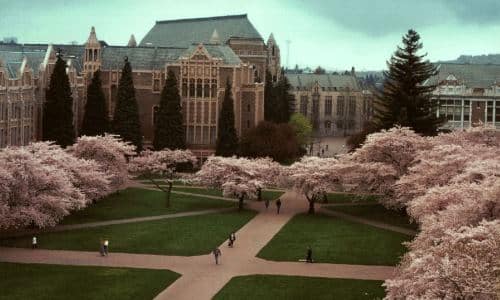
Talladega College is located on the outskirts of the city of Talladega. The campus consists of 50 acres with 17 primary buildings 3 of which are National Historic Landmarks. The Savery Library completed in 1939 was built to replace a 1907 structure built with a donation from Andrew Carnegie. The Library houses hundreds of thousands of serials, a record Room, a fully equipped computer laboratory, a unique Archives Room, and the historic Amistad murals painted by Hale Woodruff. Embedded in the floor of the library is a mural of La Amistad that school tradition says must never be stepped upon. The revolt that took place upon the ship is depicted upon the surrounding walls. Finally the mezzanine floor of the library houses the Galangue Room. This room contains an extensive collection of Angolan and Nigerian artifacts.
|
Full-Time vs. Part-Time
|
Men vs. Women
|
||||
|
Race/Ethnicity
|
|
In State vs. Out-of-State
|
Top States for Incoming Freshman
|
| Percent of Students International: | 0% |
| On-Campus Housing Available: | Yes |
| Percent of Students Living On-Campus: | 189% |
| Freshman Students Required to Live on Campus: | No |
| Tuition & Fees (undergraduate) | Expenses | ||
Published Tuition and Fees: |
$ 7,128 | ||
Average Tuition for Full-Time Undergrads: |
$ 6,720 | ||
Required Fees for Full-Time Undergrads: |
$ 408 | ||
| Financial Aid | Avg. Amount Received | % of Students Receiving Aid | |
Federal Grants: |
$ 2,025 | 52% | |
Institutional Grants: |
$ 1,500 | 21% | |
Student Loans: |
$ 2,547 | 17% | |
Any Aid: |
78% |
| Acceptance Rate: | 38% (Highly Selective) |
| Test Scores | |
| SAT Scores: | |
| % of Students Submitting SAT Scores: | 4% |
| Bottom 25th Percentile: | Verbal: 270, Math: 330 |
| Top 75th Percentile: | Verbal: 470, Math: 470 |
| ACT Scores: | |
| % of Students Submitting ACT Scores: | 21% |
| Bottom 25th Percentile: | Composite: 16, Verbal: 14, Math: 14 |
| Top 75th Percentile: | Composite: 22, Verbal: 25, Math: 24 |
| Application Fee: | $ 25.00 |
| Formal Demonstration of Competencies: | Not Required |
| High School Diploma or Equivalent: | Recommended |
| High School GPA: | Required |
| High School Rank: | Recommended |
| High School Record: | Required |
| Recommendations: | Required |
| TOEFL: | Required |
| Test Scores: | Required |