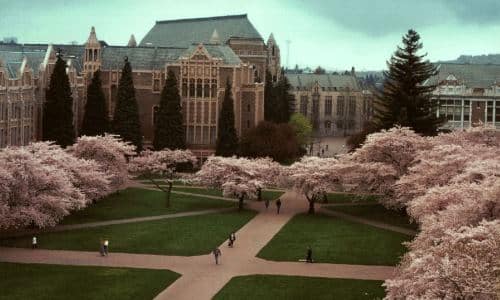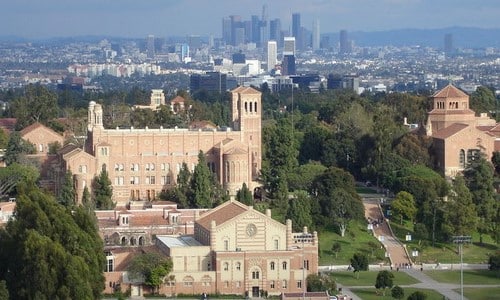
South Dakota School of Mines and Technology
501 E Saint Joseph St, Rapid City, SD 57701
School Description
Provided by South Dakota School of Mines and TechnologyThe mission of the South Dakota School of Mines and Technology is:
To prepare men and women for an enhanced qualify of life by providing a broad educational environment which fosters a quality educational experience leading to baccalaureate and post-baccalaureate degrees emphasizing science and engineering.
To contribute to the expansion of knowledge through programs of basic and applied research, scholarship, and other creative endeavors.
To utilize the special capabilities and expertise on the campus to address regional, national, and international needs.
South Dakota School of Mines and Technology
From Wikipedia, The Free EncyclopediaThe South Dakota School of Mines and Technology (SDSM&T or Mines) is a public institution of higher learning in Rapid City, South Dakota governed by the South Dakota Board of Regents. Founded in 1885 as the Dakota School of Mines, Mines offers degree programs in technical fields.
SDSM&T has an undergraduate enrollment of about 1700 students and a total enrollment of about 2300 students. The campus newspaper is The Raver. The school athletic teams are called the Hardrockers.
Academics
The school is organized into two colleges: The College of Science and Letters and the College of Engineering. Mines offers degrees in more than 16 engineering and science fields, as well as 12 master's degree programs and 4 Doctorate programs.
Bachelor of Science Programs (B.S.) Chemical Engineering, Chemistry, Civil Engineering, Computer Engineering, Computer Science, Electrical Engineering, Environmental Engineering, Geological Engineering, Geology, Industrial Engineering, Interdisciplinary Sciences, Mathematics (Applied and Computational), Mechanical Engineering, Metallurgical Engineering, Mining Engineering and Management, Physics.
Associates Degree (A.A.) General Studies
Master of Science Programs(Masters) Atmospheric Sciences, Biomedical Engineering, Chemical Engineering, Chemistry, Civil Engineering, Computer Science, Electrical Engineering, Geology and Geological Engineering, Materials Engineering and Science, Metallurgical Engineering, Mechanical Engineering, Paleontology, Technology Management
Doctoral Programs(Ph.D) Atmospheric and Environmental Sciences Ph.D., Biomedical Engineering, Geology and Geological Engineering Ph.D., Materials Engineering and Science Ph.D., Nanoscience and Nanoengineering Ph.D.,
Student organizations
Greek organizations include Alpha Chi Sigma, Alpha Delta Pi, Alpha Omega Epsilon, Delta Sigma Phi, Theta Tau, and Triangle. Student government organizations include the Resident Hall Association and the Student Association. Student media organizations include KTEQ (the campus radio station) and "the Raver" (the campus newspaper, formerly known as "the Tech").
Quick Facts
- Location:
- Midwest
- Setting:
- Large Town Setting
- Type:
- Public
- Size:
- Medium (2,000 to 5,000 Undergrad)
- Nickname:
- SDSM&T
Students & Campus Life
- Undergraduate Enrollment:
- 2,112
- On Campus Housing:
- Available
- Full Time Students:
- 96%
- Athletic Programs:
- Available
Degree Programs at South Dakota School of Mines and Technology
Associate's Level Programs
-
Arts & Humanities
-
General Studies
See more schools with programs in
General Studies
-
General Studies
An undifferentiated program that includes instruction in the general arts, general science, or unstructured studies.See more schools with programs in General Studies
-
General Studies
-
General Studies
See more schools with programs in
General Studies
Bachelor's Level Programs
-
Engineering
-
Chemical Engineering
Chemical Engineering applies the elegance of mathematical and scientific principles to the design, development and operational evaluation of systems employing chemical processes, such as chemical reactors, kinetic systems, electrochemical systems, energy conservation processes, heat and mass transfer systems, and separation processes; and the applied analysis of chemical problems such as corrosion, particle abrasion, energy loss, pollution, and fluid mechanics.See more schools with programs in Chemical Engineering
-
Electrical, Electronics and Communications Engineering
A program that prepares individuals to apply mathematical and scientific principles to the design, development and operational evaluation of electrical, electronic and related communications systems and their components, including electrical power generation systems; and the analysis of problems such as superconductor, wave propagation, energy storage and retrieval, and reception and amplification.See more schools with programs in Electrical, Electronics and Communications Engineering
-
Environmental/Environmental Health Engineering
A program that prepares individuals to apply mathematical and scientific principles to the design, development and operational evaluation of systems for controlling contained living environments and for monitoring and controlling factors in the external natural environment, including pollution control, waste and hazardous material disposal, health and safety protection, conservation, life support, and requirements for protection of special materials and related work environments.See more schools with programs in Environmental/Environmental Health Engineering
-
General Civil Engineering
A program that generally prepares individuals to apply mathematical and scientific principles to the design, development and operational evaluation of structural, load-bearing, material moving, transportation, water resource, and material control systems; and environmental safety measures.See more schools with programs in General Civil Engineering
-
General Computer Engineering
A program that generally prepares individuals to apply mathematical and scientific principles to the design, development and operational evaluation of computer hardware and software systems and related equipment and facilities; and the analysis of specific problems of computer applications to various tasks.See more schools with programs in General Computer Engineering
-
Geological/Geophysical Engineering
A program that prepares individuals to apply mathematical and geological principles to the analysis and evaluation of engineering problems, including the geological evaluation of construction sites, the analysis of geological forces acting on structures and systems, the analysis of potential natural resource recovery sites, and applied research on geological phenomena.See more schools with programs in Geological/Geophysical Engineering
-
Industrial Engineering
A program that prepares individuals to apply scientific and mathematical principles to the design, improvement, and installation of integrated systems of people, material, information, and energy. Includes instruction in applied mathematics, physical sciences, the social sciences, engineering analysis, systems design, computer applications, and forecasting and evaluation methodology.See more schools with programs in Industrial Engineering
-
Mechanical Engineering
A program that prepares individuals to apply mathematical and scientific principles to the design, development and operational evaluation of physical systems used in manufacturing and end-product systems used for specific uses, including machine tools, jigs and other manufacturing equipment; stationary power units and appliances; engines; self-propelled vehicles; housings and containers; hydraulic and electric systems for controlling movement; and the integration of computers and remote control with operating systems.See more schools with programs in Mechanical Engineering
-
Metallurgical Engineering
A program that prepares individuals to apply mathematical and metallurgical principles to the design, development and operational evaluation of metal components of structural, load-bearing, power, transmission, and moving systems; and the analysis of engineering problems such as stress, creep, failure, alloy behavior, environmental fluctuations, stability, electromagnetic and thermodynamic characteristics, optimal manufacturing processes, and related design considerations.See more schools with programs in Metallurgical Engineering
-
Mining and Mineral Engineering
A program that prepares individuals to apply mathematical and scientific principles to the design, development and operational evaluation of mineral extraction, processing and refining systems, including open pit and shaft mines, prospecting and site analysis equipment and instruments, environmental and safety systems, mine equipment and facilities, mineral processing and refining methods and systems, and logistics and communications systems.See more schools with programs in Mining and Mineral Engineering
-
Chemical Engineering
-
Interdisciplinary Studies
-
Multi-/Interdisciplinary Studies
Any instructional program that is derived from two or more distinct programs to provide a cross-cutting focus on a subject concentration that is not subsumed under a single discipline or occupational field.See more schools with programs in Multi-/Interdisciplinary Studies
-
Multi-/Interdisciplinary Studies
-
Mathematics and Statistics
-
General Mathematics
A general program that focuses on the analysis of quantities, magnitudes, forms, and their relationships, using symbolic logic and language. Includes instruction in algebra, calculus, functional analysis, geometry, number theory, logic, topology and other mathematical specializations.See more schools with programs in General Mathematics
-
General Mathematics
-
Natural Sciences
-
Chemistry
See more schools with programs in
Chemistry
-
General Chemistry
A general program that focuses on the scientific study of the composition and behavior of matter, including its micro- and macro-structure, the processes of chemical change, and the theoretical description and laboratory simulation of these phenomena.See more schools with programs in General Chemistry
-
General Chemistry
-
Geology
See more schools with programs in
Geology
-
Geology/Earth Science
A program that focuses on the scientific study of the earth; the forces acting upon it; and the behavior of the solids, liquids and gases comprising it. Includes instruction in historical geology, geomorphology, and sedimentology, the chemistry of rocks and soils, stratigraphy, mineralogy, petrology, geostatistics, volcanology, glaciology, geophysical principles, and applications to research and industrial problems.See more schools with programs in Geology/Earth Science
-
Geology/Earth Science
-
Physics
See more schools with programs in
Physics
-
General Physics
A general program that focuses on the scientific study of matter and energy, and the formulation and testing of the laws governing the behavior of the matter-energy continuum. Includes instruction in classical and modern physics, electricity and magnetism, thermodynamics, mechanics, wave properties, nuclear processes, relativity and quantum theory, quantitative methods, and laboratory methods.See more schools with programs in General Physics
-
General Physics
-
Chemistry
See more schools with programs in
Chemistry
-
Technology
-
Software Development
See more schools with programs in
Software Development
-
Computer and Information Sciences
A general program that focuses on computing, computer science, and information science and systems as part of a broad and/or interdisciplinary program. Such programs are undifferentiated as to title and content and are not to be confused with specific programs in computer science, information science, or related support services.See more schools with programs in Computer and Information Sciences
-
Computer and Information Sciences
-
Software Development
See more schools with programs in
Software Development
Master's Level Programs
-
Engineering
-
Chemical Engineering
Chemical Engineering applies the elegance of mathematical and scientific principles to the design, development and operational evaluation of systems employing chemical processes, such as chemical reactors, kinetic systems, electrochemical systems, energy conservation processes, heat and mass transfer systems, and separation processes; and the applied analysis of chemical problems such as corrosion, particle abrasion, energy loss, pollution, and fluid mechanics.See more schools with programs in Chemical Engineering
-
Electrical, Electronics and Communications Engineering
A program that prepares individuals to apply mathematical and scientific principles to the design, development and operational evaluation of electrical, electronic and related communications systems and their components, including electrical power generation systems; and the analysis of problems such as superconductor, wave propagation, energy storage and retrieval, and reception and amplification.See more schools with programs in Electrical, Electronics and Communications Engineering
-
Engineering/Industrial Management
A program that focuses on the application of engineering principles to the planning and operational management of industrial and manufacturing operations, and prepares individuals to plan and manage such operations. Includes instruction in accounting, engineering economy, financial management, industrial and human resources management, industrial psychology, management information systems, mathematical modeling and optimization, quality control, operations research, safety and health issues, and environmental program management.See more schools with programs in Engineering/Industrial Management
-
General Civil Engineering
A program that generally prepares individuals to apply mathematical and scientific principles to the design, development and operational evaluation of structural, load-bearing, material moving, transportation, water resource, and material control systems; and environmental safety measures.See more schools with programs in General Civil Engineering
-
Geological/Geophysical Engineering
A program that prepares individuals to apply mathematical and geological principles to the analysis and evaluation of engineering problems, including the geological evaluation of construction sites, the analysis of geological forces acting on structures and systems, the analysis of potential natural resource recovery sites, and applied research on geological phenomena.See more schools with programs in Geological/Geophysical Engineering
-
Materials Engineering
A program that prepares individuals to apply mathematical and materials science principles to the design, development and operational evaluation of materials and related processes used in manufacturing in a wide variety of settings; the synthesis of new industrial materials, including marrying and bonding composites; analysis of materials requirements and specifications; and related problems of system design dependent on materials factors.See more schools with programs in Materials Engineering
-
Mechanical Engineering
A program that prepares individuals to apply mathematical and scientific principles to the design, development and operational evaluation of physical systems used in manufacturing and end-product systems used for specific uses, including machine tools, jigs and other manufacturing equipment; stationary power units and appliances; engines; self-propelled vehicles; housings and containers; hydraulic and electric systems for controlling movement; and the integration of computers and remote control with operating systems.See more schools with programs in Mechanical Engineering
-
Chemical Engineering
-
Natural Sciences
-
Paleontology
A program that focuses on the scientific study of extinct life forms and associated fossil remains, and the reconstruction and analysis of ancient life forms, ecosystems, and geologic processes. Includes instruction in sedimentation and fossilization processes, fossil chemistry, evolutionary biology, paleoecology, paleoclimatology, trace fossils, micropaleontology, invertebrate paleontology, vertebrate paleontology, paleobotany, field research methods, and laboratory research and conservation methods.See more schools with programs in Paleontology
-
Meteorology
See more schools with programs in
Meteorology
-
General Atmospheric Sciences and Meteorology
A general program that focuses on the scientific study of the composition and behavior of the atmospheric envelopes surrounding the earth, the effect of earth's atmosphere on terrestrial weather, and related problems of environment and climate. Includes instruction in atmospheric chemistry and physics, atmospheric dynamics, climatology and climate change, weather simulation, weather forecasting, climate modeling and mathematical theory; and studies of specific phenomena such as clouds, weather systems, storms, and precipitation patterns.See more schools with programs in General Atmospheric Sciences and Meteorology
-
General Atmospheric Sciences and Meteorology
-
Paleontology
-
Technology
-
Software Development
See more schools with programs in
Software Development
-
Computer and Information Sciences
A general program that focuses on computing, computer science, and information science and systems as part of a broad and/or interdisciplinary program. Such programs are undifferentiated as to title and content and are not to be confused with specific programs in computer science, information science, or related support services.See more schools with programs in Computer and Information Sciences
-
Computer and Information Sciences
-
Software Development
See more schools with programs in
Software Development
Students
General
|
Full-Time vs. Part-Time
|
Men vs. Women
|
||||
|
Race/Ethnicity
|
Geography
|
In State vs. Out-of-State
|
Top States for Incoming Freshman
|
| Percent of Students International: | 4% |
Housing
| On-Campus Housing Available: | Yes |
| Percent of Students Living On-Campus: | 34% |
| Freshman Students Required to Live on Campus: | Yes |
Athletics
| Member of: | NAA, NAIA |
| Sports Include: |
Football (Dakota Athletic Conference) Basketball (Dakota Athletic Conference) Track (Dakota Athletic Conference) |
| Tuition & Fees (undergraduate) | In-State | Out-of-State | |
Published Tuition and Fees: |
$ 5,070 | $ 10,060 | |
Average Tuition for Full-Time Undergrads: |
$ 2,290 | $ 7,280 | |
Required Fees for Full-Time Undergrads: |
$ 2,780 | $ 2,780 | |
| Financial Aid | Avg. Amount Received | % of Students Receiving Aid | |
Federal Grants: |
$ 3,434 | 35% | |
State and Local Grants: |
$ 2,182 | 33% | |
Institutional Grants: |
$ 1,564 | 29% | |
Student Loans: |
$ 3,797 | 63% | |
Any Aid: |
85% |
Selectivity (Undergraduate Only)
| Acceptance Rate: | 94% (Selective) |
| Test Scores | |
| ACT Scores: | |
| % of Students Submitting ACT Scores: | 93% |
| Bottom 25th Percentile: | Composite: 22, Verbal: 20, Math: 22 |
| Top 75th Percentile: | Composite: 27, Verbal: 26, Math: 28 |
Application Requirements (Undergraduate Only)
| Application Fee: | $ 20.00 |
| Formal Demonstration of Competencies: | Not Required |
| High School Diploma or Equivalent: | Required |
| High School GPA: | Required |
| High School Rank: | Required |
| High School Record: | Required |
| Recommendations: | Not Required |
| TOEFL: | Required |
| Test Scores: | Required |