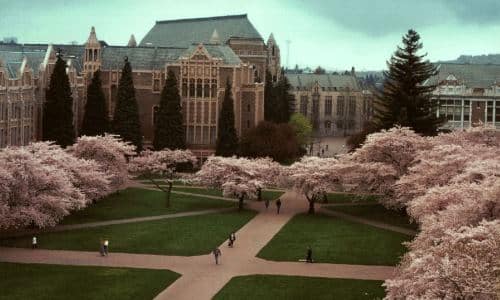
Freed-Hardeman University is a private institution, associated with churches of Christ, dedicated to moral and spiritual values, academic excellence, and service in a friendly, supportive environment. The purpose of the university is to provide every student an undergraduate or graduate education permeated with these Christian values.
Freed-Hardeman University is primarily an undergraduate university in Henderson, Tennessee in the United States of America. The university is located within a short distance of the town's central area. The university traces its heritage to the members of the Churches of Christ who helped build it. Freed-Hardeman is primarily undergraduate and residential, meaning it enrolls full time students of traditional college age. The university also serves some commuting, part-time, and older adult students on-campus and through distance-learning programs. The university offers a limited number of master's-level graduate programs including Bible, Business, Counseling and Education. Arts, science, and professional degrees are conferred.
The university is governed by a board of trustees, all of whom are required to be members of the Churches of Christ. Courses are offered by 12 academic departments organized into six schools – Arts and Humanities, Biblical, Business, Education, Sciences and Mathematics, and the Honors College. The Loden-Daniel Library services the undergraduate and graduate students, as well as faculty and staff.
Freed-Hardeman traces its origin to the 1869 charter of a private high school and college for Henderson, the Henderson Male Institute. It was known at various times as the Henderson Masonic Male and Female Institute, West Tennessee Christian College, Georgie Robertson Christian College, National Teachers' Normal and Business College; and (as of 1919) Freed-Hardeman College. In February of 1990, it became Freed-Hardeman University.
The university has five women's dormitories. Hall-Roland Hall (originally Oakland Hall) is the oldest residence hall. The ground floor houses a Personal Counseling Center, Graduate Studies in Counseling, and the Department of Behavioral and Consumer Sciences. H. A. Dixon Hall is a four story dormitory opened in 1958. It can house up to 136 residents. Thomas E. and LaVonne B. Scott Hall opened in 1971 and can house 152 students. In 1973 W. A. Bradfield Hall opened. It houses 144 students. Porter-Terry Hall opened in 1977 and can house up to 156 students.
|
Full-Time vs. Part-Time
|
Men vs. Women
|
||||
|
Race/Ethnicity
|
|
In State vs. Out-of-State
|
Top States for Incoming Freshman
|
| Percent of Students International: | 1% |
| On-Campus Housing Available: | Yes |
| Percent of Students Living On-Campus: | 83% |
| Freshman Students Required to Live on Campus: | No |
| Member of: | NAA, NAIA |
| Sports Include: |
Basketball (TranSouth Athletic Conference) Baseball (TranSouth Athletic Conference) |
| Tuition & Fees (undergraduate) | Expenses | ||
Published Tuition and Fees: |
$ 12,440 | ||
Average Tuition for Full-Time Undergrads: |
$ 10,500 | ||
Required Fees for Full-Time Undergrads: |
$ 1,940 | ||
| Financial Aid | Avg. Amount Received | % of Students Receiving Aid | |
Federal Grants: |
$ 3,078 | 35% | |
State and Local Grants: |
$ 4,676 | 10% | |
Institutional Grants: |
$ 4,119 | 94% | |
Student Loans: |
$ 3,731 | 83% | |
Any Aid: |
98% |
| Acceptance Rate: | 99% (Selective) |
| Test Scores | |
| SAT Scores: | |
| % of Students Submitting SAT Scores: | 16% |
| Bottom 25th Percentile: | Verbal: 510, Math: 490 |
| Top 75th Percentile: | Verbal: 600, Math: 610 |
| ACT Scores: | |
| % of Students Submitting ACT Scores: | 90% |
| Bottom 25th Percentile: | Composite: 20, Verbal: 20, Math: 19 |
| Top 75th Percentile: | Composite: 26, Verbal: 28, Math: 26 |
| Formal Demonstration of Competencies: | Not Required |
| High School Diploma or Equivalent: | Not Required |
| High School GPA: | Required |
| High School Rank: | Recommended |
| High School Record: | Required |
| Recommendations: | Recommended |
| TOEFL: | Required |
| Test Scores: | Required |