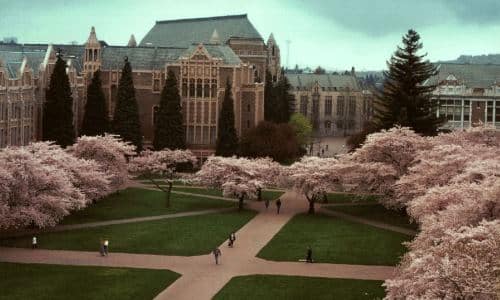
Kansas State University

Anderson Hall
Anderson Hall
[source]
K-State: It's the Place To Be (Part One)

School Description

Provided by Kansas State University

Mission Statement

The mission of the Mechanical and Nuclear Engineering Department undergraduate program is to produce high-quality baccalaureate graduates who are capable of contributing valuable engineering skills and knowledge toward areas of mechanical and nuclear engineering by:

* offering a modem curriculum accredited by the Accreditation Board for Engineering and Technology that prepares students for lifetime careers;
* acknowledging that professional education is a shared responsibility between both students and faculty;
* providing well-prepared and presented courses that challenge students;
* advising undergraduate students to help them negotiate obstacles in their educational path, and to tailor their education to their strengths and interests;
* recruiting and attracting top high school graduates and transfer students; and
* producing an environment within the department that motivates students to fully develop their engineering education through participation in professional societies, student government, extracurricular activities, design competitions, etc.

In consultation with the stakeholders for our baccalaureate program, the MINE department has established the following Program Objectives (what we expect students to accomplish in their careers) and Program Outcomes (what we expect students to accomplish on graduation).

Program Educational Objectives

Engineering is the application of scientific principles to practical ends as the design, construction, and operation of efficient and economical structures, equipment, and systems. As engineers, graduates of the Mechanical and Nuclear Engineering Department will

1. apply technical knowledge and skills in their chosen profession or toward advanced study to the greater benefit of society and the State of Kansas.
2. utilize effective communication and team skills to work productively within their professions and communities.
3. demonstrate integrity, responsibility, and accountability in their professional activities, and will actively participate in life-long learning and professional development.

In order to ensure that these objectives are achieved, the department has established a set of program outcomes that describe the expected abilities of our graduates, developed measurement and assessment processes to evaluate the outcomes, and developed adjustment processes to refine the programmatic elements.

Program Outcomes (Inclusive of K-State Undergraduate Student Learning Outcomes)

Graduates of the Mechanical and Nuclear Engineering Department will have:

1. an ability to apply knowledge of mathematics (through multivariate calculus and differential equations, statistics, and linear algebra), science (including chemistry and calculus-based physics with depth in one), and engineering
2. an ability to design and conduct experiments, as well as to analyze and interpret data
3. an ability to design a system, component, or process to meet desired needs
4. an ability to function on multi-disciplinary teams
5. an ability to identify, formulate, and solve engineering problems
6. an understanding of professional and ethical responsibility
7. an ability to communicate effectively
8. the broad education necessary to understand the impact of engineering solutions in a global and societal context
9. a recognition of the need for, and an ability to engage in life-long learning
10. a knowledge of contemporary issues
11. an ability to use the techniques, skills, and modern engineering tools necessary for engineering practice
12. the ability to work at a professional level for both thermal and mechanical systems including the design and realization of such systems

< Collapse

Kansas State University

From Wikipedia, The Free Encyclopedia

Kansas State University, officially named "Kansas State University of Agriculture and Applied Science" but commonly shortened to K-State, is an institution of higher learning located in Manhattan, Kansas, in the United States. A branch campus, including the College of Technology and Aviation, is located in Salina, Kansas. Kansas State has an official enrollment of 23,332 students for the 2007–2008 school year.

History

Kansas State University, originally named Kansas State Agricultural College, was founded on February 16, 1863 as a Land Grant institution under the Morrill Act. The school was the first Land Grant college newly created under the Morrill Act although several other universities claim to be the oldest Land Grant school. K-State is the fourth-oldest school in the Big 12 Conference and the oldest public university in the state of Kansas.

The institution was initially located on the grounds of the old Bluemont Central College, which was incorporated in Manhattan by the Kansas Territorial legislature in 1858. The university moved to its present site in 1875.

The early years of the institution witnessed debate over whether the college should provide a focused agricultural education or a full liberal arts education. During this era, the tenor of the school shifted with the tenure of the Presidents. For example, President John A. Anderson (1873-1879) favored a limited education and President George T. Fairchild (1879-1897) favored a classic liberal education. Also during this era, in 1882, the study of home economics originated at Kansas State. Currently, the university offers a full range of majors and many graduate programs.

Recent history

The name of the school was changed in 1931 to Kansas State College of Agriculture and Applied Science. In 1959, the name was changed again to Kansas State University to reflect a growing number of graduate programs. From 1943 to 1950, Milton S. Eisenhower was President of the University, being succeeded by Dr. James McCain, who served from 1950 to 1975. Buildings, including residence halls and a student union, were added to the campus in the 1950s. The 1960s witnessed demonstrations against the Vietnam war, though fewer than at other college campuses. Enrollment was relatively high through most of the 1970s, but the university endured a downward spiral from approximately 1976 to 1986, when enrollment decreased to 17,570 and a number of faculty resigned. In 1986, Dr. Jon Wefald assumed the presidency of Kansas State University. The university community responded well to Wefald's management style, and enrollment and donations increased under his leadership. Wefald also introduced an innovative student recruitment office, which lured students from all over Kansas and the United States, and expanded the international student program. On May 12, 2008, Wefald announced that he would retire at the end of the 2008-2009 academic year.

< Collapse

Read the full entry on Wikipedia

Quick Facts

Chance of Admission:
Location:
Midwest
Setting:
Small Town Setting
Type:
Public
Size:
Very Large (+10,000 Undergrad)
Mascot:
Wildcats
Nicknames:
K-State, KSU

Students & Campus Life

Undergraduate Enrollment:
19,083
On Campus Housing:
Available
Full Time Students:
87%
Athletic Programs:
Available
> More Students & Campus Life

Expenses

Average Tuition:
$ 14,454
Students Receiving Aid:
67%
> More Expenses & Financial Aid

Admissions

Application Fee:
$ 30
Selectivity:
Highly Selective
> More Admissions

Students

General
Full-Time vs. Part-Time
Full-Time 87%
Part-Time 13%
Men vs. Women
Women 53%
Men 47%
Race/Ethnicity
Caucasian 89%
Other 6%
Hispanic 2%
African-American 2%
Asian 1%
Geography
In State vs. Out-of-State
In-State 85%
Out-of-State 15%
Top States for Incoming Freshman
Kansas 85%
Missouri 2%
Colorado 1%
Texas 1%
Nebraska 1%
Percent of Students International: 4%

Housing

On-Campus Housing Available: Yes
Percent of Students Living On-Campus: 18%
Freshman Students Required to Live on Campus: Yes

Athletics

Member of: NAA, NCAA
Sports Include: Football (Big Twelve Conference)
Basketball (Big Twelve Conference)
Baseball (Big Twelve Conference)
Track (Big Twelve Conference)
Tuition & Fees (undergraduate) In-State Out-of-State  
Published Tuition and Fees:
$ 5,124 $ 14,454  
Average Tuition for Full-Time Undergrads:
$ 4,560 $ 13,890  
Required Fees for Full-Time Undergrads:
$ 564 $ 564  
Financial Aid Avg. Amount Received % of Students Receiving Aid  
Federal Grants:
$ 2,615 25%  
State and Local Grants:
$ 918 15%  
Institutional Grants:
$ 2,025 67%  
Student Loans:
$ 3,756 63%  
Any Aid:
  67%  

Selectivity (Undergraduate Only)

Acceptance Rate: 48% (Highly Selective)
Test Scores  
ACT Scores:  
% of Students Submitting ACT Scores: 92%
Bottom 25th Percentile: Composite: 20, Verbal: 19, Math: 19
Top 75th Percentile: Composite: 26, Verbal: 26, Math: 26

Application Requirements (Undergraduate Only)

Application Fee: $ 30.00
Formal Demonstration of Competencies: Not Required
High School Diploma or Equivalent: Recommended
High School GPA: Recommended
High School Rank: Recommended
High School Record: Recommended
Recommendations: Not Required
TOEFL: Not Required
Test Scores: Required

Degree Programs at Kansas State University

Associate's Level Majors
Bachelor's Level Majors

College Advice

Yahoo
Is Kansas State University Hard? many of my friends have dropped out mostly because of partying and not going to class. I am attending a community college and wanted to transfer there but i am thinking about changing my mind now?
18 months ago
Best Answer
It depends on what you plan to do. If you actually go to class (or at least keep up with the readings), you'll be fine. The teachers are fair (for the most part) and genuinely want to help you. Of course it will be harder than Cowley/Butler/Highland/whatever....but not impossible. The only ridiculously hard classes are intro ones like Chem I-II and Calc I-III, or if you plan on going pre-med, pre-vet, or into engineering. BUT if you spend every night in the 'Ville, or at some house down in the "student ghetto" doing kegstands and Jello shots when you should be studying for your finals---then yes, you will flunk out. Go to class, limit your drinking to Thurs-Sat, and DON'T live in the Commons, and you'll be fine.

Photos

  • Anderson Hall
    Anderson Hall [source]
  • Hale Library
    Hale Library [source]
  • Waters Quad just North of Hale Library
    Waters Quad just North of Hale Library [source]
  • Northern Campus in October
    Northern Campus in October [source]
  • Bluemont Bell and Dickens Hall
    Bluemont Bell and Dickens Hall [source]
  • Dickens Hall, from a 1907 postcard
    Dickens Hall, from a 1907 postcard [source]
  • Powercat
    Powercat [source]
  • [source]

Videos

  • K-State: It's the Place To Be (Part One)
  • K-State: It's the Place To Be (Part Two)
Tell This School You're Interested!
Why is this important?