School Description

Provided by Whitman College

Whitman College is committed to providing an excellent, well-rounded liberal arts and sciences undergraduate education. It is an independent, nonsectarian, and residential college. Whitman offers an ideal setting for rigorous learning and scholarship and encourages creativity, character, and responsibility.

Through the study of humanities, arts, and social and natural sciences, Whitman's students develop capacities to analyze, interpret, criticize, communicate, and engage. A concentration on basic disciplines, in combination with a supportive residential life program that encourages personal and social development, is intended to foster intellectual vitality, confidence, leadership, and the flexibility to succeed in a changing technological, multicultural world.

< Collapse

Whitman College

From Wikipedia, The Free Encyclopedia

Whitman College is a co-educational, non-sectarian residential undergraduate liberal arts college in Walla Walla, Washington.

History

In 1836 the missionaries Marcus and Narcissa Whitman established a medical mission and a school a few miles from the modern-day city of Walla Walla to serve the Cayuse Indians and immigrants on the Oregon Trail. After the Whitmans were killed in the 1847 Whitman Massacre, the Rev. Cushing Eells resolved to establish a school in their honor. The Washington Territorial Legislature granted a charter to Whitman Seminary on December 20, 1859. On November 28, 1883, the legislature amended the charter, changing the name to Whitman College and the school to a four-year, degree-granting college. The modern-day Whitman College has no religious affiliation.

In 1913, Whitman became the first college or university in the nation to require undergraduate students to complete comprehensive oral and written examinations in their major fields. Individual majors also require an extensive project in the form of either a written or multimedia thesis or a presentation or recital. In 1920, a Phi Beta Kappa Chapter was installed, the second for any college in the Pacific Northwest.

Campus

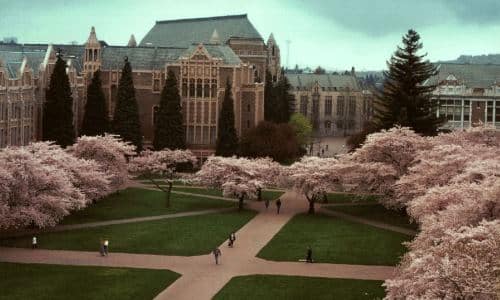
The campus includes streams, record-holding trees and numerous outdoor sculptures. It is built around Ankeny Field, which provides structure to the architectural layout, but also serves as a popular social destination on warm days. College Creek meanders through the main campus, forming ponds (most notably Lakum Duckum) and providing a habitat for Whitman's many ducks.

About 75% of the student body resides in school housing. Two of eight residence halls date to the early 1900s and several residence buildings are of neoclassical architectural design. There are eleven "Interest House" residences which are mostly of Victorian and classical design. Academic facilities are newer and of more modern design.

< Collapse

Read the full entry on Wikipedia

Quick Facts

Chance of Admission:
Location:
Northwest
Setting:
Small Town Setting
Type:
Private
Size:
Small (Under 2,000 Undergrad)
Mascot:
Missionaries

Students & Campus Life

Undergraduate Enrollment:
1,454
On Campus Housing:
Available
Full Time Students:
100%
Athletic Programs:
Available
> More Students & Campus Life

Expenses

Average Tuition:
$ 28,400
Students Receiving Aid:
87%
> More Expenses & Financial Aid

Admissions

Application Fee:
$ 45
Selectivity:
Highly Selective
> More Admissions

Students

General
Full-Time vs. Part-Time
Full-Time 100%
Part-Time 0%
Men vs. Women
Women 50%
Men 50%
Race/Ethnicity
Caucasian 71%
Other 16%
Asian 8%
Hispanic 3%
African-American 2%
Geography
In State vs. Out-of-State
Out-of-State 62%
In-State 38%
Top States for Incoming Freshman
Washington 38%
Oregon 19%
California 12%
Colorado 3%
Idaho 3%
Percent of Students International: 3%

Housing

On-Campus Housing Available: Yes
Percent of Students Living On-Campus: 56%
Freshman Students Required to Live on Campus: Yes

Athletics

Member of: NAA, NCAA
Sports Include: Basketball (Northwest Conference)
Baseball (Northwest Conference)
Track (Northwest Conference)
Tuition & Fees (undergraduate) Expenses  
Average Tuition for Full-Time Undergrads:
$ 28,400    
Required Fees for Full-Time Undergrads:
$ 240    
Financial Aid Avg. Amount Received % of Students Receiving Aid  
Federal Grants:
$ 3,000 9%  
State and Local Grants:
$ 2,033 16%  
Institutional Grants:
$ 11,546 78%  
Student Loans:
$ 2,898 47%  
Any Aid:
  87%  

Selectivity (Undergraduate Only)

Acceptance Rate: 47% (Highly Selective)
Test Scores  
SAT Scores:  
% of Students Submitting SAT Scores: 82%
Bottom 25th Percentile: Verbal: 620, Math: 620
Top 75th Percentile: Verbal: 720, Math: 700

Application Requirements (Undergraduate Only)

Application Fee: $ 45.00
Formal Demonstration of Competencies: Not Required
High School Diploma or Equivalent: Required
High School GPA: Required
High School Rank: Recommended
High School Record: Required
Recommendations: Required
TOEFL: Required
Test Scores: Required

Degree Programs at Whitman College

Bachelor's Level Majors

College Advice

Yahoo
DD
DD
Does anyone know what these are like?
19 months ago
Best Answer
I'm in Eugene, OR, and I know something of these two. As for Whitman, take a look at the web page for Loren Pope's little book, "Colleges That Change Lives". Whitman is one of the 40 schools that he raves about. http://www.ctcl.com/colleges/whitman/index.htm His book is a lot better than the web page. I bet your HS library has a copy; if your school has some sort of college counselor, I'm sure she'll have a copy, too. Definitely worth reading. I'd also add that Walla Walla is a wonderful, clean and beautiful small city. I have been there and liked it a lot. Oregon State. Up the road 40 miles. PAC 10 university. Big school. Corvallis is sort of the classical college town. There's other businesses there (like Hewlett Packard), but the U dominates everything. Like all large schools, you won't get much individual attention like you would at a small school. On the other hand, large schools offer everything, which small schools cannot. Depends on what you want. These two schools are very different. If you like one a lot, you'll hate the other. Because of this, you definitely should visit both campuses. (Pope's book has good advice on how to do this visit right.) After you visit, your decision will probably be easy.

Photos

  • "Styx" (2002), by Deborah Butterfield, sits on Ankeny Field.
    "Styx" (2002), by Deborah Butterfield, sits on Ankeny Field. [source]
  • [source]
  • The Memorial Building, built in 1899, houses administrative offices.
    The Memorial Building, built in 1899, houses administrative offices. [source]
Tell This School You're Interested!
Why is this important?