University of Oregon

Quick Facts

Chance of Admission:
Location: Northwest
Setting: Mid-size City Setting
Type: Public
Size: Very Large (+10,000 Undergrad)
Mascot: Ducks
Nickname: UO
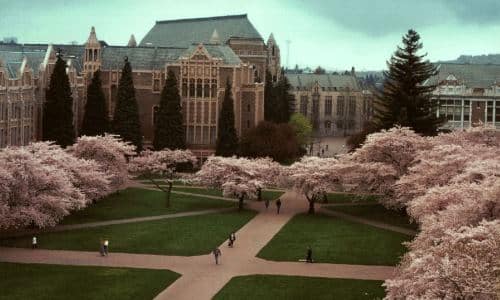
View of the Memorial Quad, facing south. The Knight Library can be seen in the distance.
[source]
University of Oregon From Wikipedia, The Free Encyclopedia

The University of Oregon (UO) is a public, coeducational research university in Eugene, Oregon, United States. The second oldest public university in the state, UO was founded in 1876, and graduated its first class two years later. The University of Oregon is one of 60 members of the Association of American Universities. The Carnegie Foundation classifies the University of Oregon as a "high research activity" university. Former Oregon Attorney General David B. Frohnmayer is the president of the university. The UO receives much of its funding from the UO Foundation, an independent not-for-profit organization. In 2007, the school was ranked 112th (tie) in the national university category by U.S. News and World Report's annual college rankings.

Institution

Colleges and schools

The University of Oregon is organized into eight schools and colleges—six professional schools and colleges, an Arts and Sciences College and an Honors College.

School of Architecture and Allied Arts

The School of Architecture and Allied Arts (called "triple-A" or "AAA") was founded by Ellis F. Lawrence in 1914. The school offers undergraduate and graduate degrees in architecture, art, including digital arts, arts and administration, art history, historic preservation, interior architecture, landscape architecture, and planning, public policy and management, and product design. The school also offers an architectural program, digital arts program, and product design program in Portland, Oregon.

The school offers the only accredited degree in architecture, landscape architecture, and interior architecture in Oregon. The National Architectural Accrediting Board accredits both the undergraduate bachelor of architecture five-year degree and the master of architecture. Other nationally accredited degrees include the planning and public administration, landscape architecture, and interior architecture programs.

< Collapse

Read the full entry on Wikipedia

Students & Campus Life
Undergraduate Enrollment: 15,983
On Campus Housing: Available
Full Time Students: 98%
Athletic Programs: Available
> More Students & Campus Life
Expenses
Average Tuition: $ 17,445
Students Receiving Aid: 70%
> More Expenses & Financial Aid
Admissions
Application Fee: $ 50
Selectivity: Selective
> More Admissions

Students

General
Full-Time vs. Part-Time
Full-Time 98%
Part-Time 2%
Men vs. Women
Women 56%
Men 44%
Race/Ethnicity
Caucasian 78%
Other 12%
Asian 6%
Hispanic 3%
African-American 1%
Geography
In State vs. Out-of-State
In-State 68%
Out-of-State 32%
Top States for Incoming Freshman
Oregon 68%
California 13%
Washington 3%
Hawaii 1%
Colorado 1%
Percent of Students International: 5%

Housing

On-Campus Housing Available: Yes
Percent of Students Living On-Campus: 17%
Freshman Students Required to Live on Campus: No

Athletics

Member of: NAA, NCAA
Sports Include: Football (Pacific-10 Conference)
Basketball (Pacific-10 Conference)
Track (Pacific-10 Conference)
Tuition & Fees (undergraduate) In-State Out-of-State  
Published Tuition and Fees:
$ 5,613 $ 17,445  
Average Tuition for Full-Time Undergrads:
$ 4,164 $ 15,996  
Required Fees for Full-Time Undergrads:
$ 1,449 $ 1,449  
Financial Aid Avg. Amount Received % of Students Receiving Aid  
Federal Grants:
$ 3,236 18%  
State and Local Grants:
$ 1,365 7%  
Institutional Grants:
$ 1,788 55%  
Student Loans:
$ 3,807 40%  
Any Aid:
  70%  

Selectivity (Undergraduate Only)

Acceptance Rate: 91% (Selective)
Test Scores  
SAT Scores:  
% of Students Submitting SAT Scores: 92%
Bottom 25th Percentile: Verbal: 500, Math: 500
Top 75th Percentile: Verbal: 610, Math: 620

Application Requirements (Undergraduate Only)

Application Fee: $ 50.00
Formal Demonstration of Competencies: Not Required
High School Diploma or Equivalent: Required
High School GPA: Required
High School Rank: Not Required
High School Record: Required
Recommendations: Not Required
TOEFL: Required
Test Scores: Required

Degree Programs at University of Oregon

Bachelor's Level Majors

College Advice

Yahoo
i am going to be a senior this year, and i am wondering how hard it is to get into the college with a cumulative gpa of 3.0-3.2. I have not taken my sat's so i can't tell you bout those, if you could give me examples that would be great, and if you could also tell me about their business and art programs that would be great. thank you :0)
13 months ago
Best Answer
Hi! I am currently a student at the university of oregon. A 3.5 is automatic admission. WIth a 3.0 you could still get in, you just have to write a really great admissions essay. You can do it, go onto their website and check other admission requirements and tips.-www.uoregon.edu and I hope you get in it's an awesome school with a great atmosphere.
My three choices are Sonoma State, Monterey Bay State University, and the University of Eugene in Oregon. I'm from California and so thats why I'm mostly leaning towards staying, just to be closer to my family. But I really really love Oregon, its way cheaper and so pretty there. If there's anyone who's gone to any of these, can you give me some feedback?
14 months ago
Best Answer
Go to Oregon, I think you get the good neighbor fee too (double check me on that- I'm a CA resident attending in NV and I qualify for the good neighbor.) Unfortunately, it's a choice on whether or not your ready to move away from your family and stake out your social place away from the close support. Just remember you will gain some new support by making new friends and enhance your growing self confidence. Personally, I would go to OR. You can always transfer back. Besides, it's not the end all be all. Good Luck!
I'm looking to transfer to a four-year college in 2009 with a major in computer science, but I'm not sure which four year offers a better Computer Science program.
16 months ago
Best Answer
U of O is stronger in software stuff. If you are looking for a more hardware, electrical engineering type degree then OSU.
My roommate and I are looking to move into a two-bedroom place next school year and are trying to find an affordable (under $450 for each of us) yet nice place to live in Eugene. Any ideas or experiences? Thanks.
16 months ago
Best Answer
A relative of mine used to magange some apartments that were just east of the U and south of Highway 99. They were clean and quiet, preferred to rent to college students who needed an apartment without roudy neighbors. They are located just down the street from the Market of Choice grocery store about 3-4 blocks. Don't recall their name and of course that may have changed. But there are several complexes in this general area that would be similar to check out. With the new bus system, would be great for commuting to the school too.
I want to go to the University of Oregon. It's about 10,000 dollars more expensive than the University of Colorado (because at CU I'm in-state), and I have a feeling my mom is going to try to use that as an excuse for me to go to CU instead. I DO NOT want to go to CU, I would rather move to Oregon and work for a year than go there, as bratty as that seems. I need to get out of here. Are there any suggestions as to handling my mother, money, or any other things? I'm applying for scholarships and am trying to figure out all of the aid information and praying that when she makes her "comparative spreadsheet" the aid looks rather convincing. I'm asking for anything, anything at all. Thanks so much.
16 months ago
Best Answer
OK, if you want to go to Oregon to get away from your parents and it's for yourself then there's nothing wrong with that but if you want to go for a boy, then that is the wrongest reason there ever was one. Now that that's out of the way, there are so many things you can do to pay for school; aid, scholarships, and loans specifically. With aid(grants and the sort) and loans all the paper work requires you to show that you're independent of your parents otherwise they need to sign paperwork. Also, the amount of money they make can adversely affect the amount you could recieve. Taking a year off and filing your own taxes, having your own place, etc so you can show you're independent of your parents will net you the most money. I work in the service industry and don't claim all of my tips because the less I make the more aid I get, but that has actually affected me with a car loan when my income was too low for a loan. All this stuff is pretty easy to fill out and I would get the ball rolling with your financial aid.-----Go to fafsa.gov to fill out your Free Application For Student Aid, that is the most important and put all schools you're interested in. Then you need to fill out the proper financial aid paperwork for the schools you plan on attending, but that can only happen after acceptance. Now, aid goes to the most needy and loans will go to about anyone. In Florida, I receive about $2,500 in grants per semester and $5,500 in loans per semester as a junior(it's less as a freshman and sophomore), so that comes out to about $8,000 which is more than enough for tuition and books and I have plenty of money left over to live off of(housing, food, etc...) which is what it's for. Since I am an in-state student my tuition doesn't even break the $2,000 per semester mark, so I have it extremely lucky, but if my tuition was what you're talking about without all the help there would be no way and it would still be hard with the help. If I could make a suggestion, it would be to try out the local school and see how you like it. If you do go to Oregon, gain local residency for sure(which it sounds like you're planning on doing) and find out exactly what it takes to establish independence so the amount of aid you recieve depends on your income and not your parents. If your parents decide to help, that would obviously be best, but it doesn't sound like you're going to accept their conditions and their not going to accept yours. Whatever you do, plan, plan, plan, and be safe. The world is an extremely dangerous place for a young woman on her own. I know that sounds corny, but it's true. Good Luck.
Q
Q
Wut does everyone think of UO? thanks for your help, im thinking about going there, but just wanting to hear other people thoughts about the school
17 months ago
Best Answer
Well I graduated from Oregon State University...so I'm biased..GO Beavs! but...if you are looking into majoring in the libral arts I guess I have to say the UO is a pretty good school. I have a lot of friends that have graduated from there and enjoyed it. OSU is better suited for science and technical majors. Both are very good schools. Good luck on your choice! :-)
I know where it ranks as far as the US News and Princeton Review, but what is the general consensus from employers and academics alike?
23 months ago
Best Answer
Not having been to the school, I can only speak from experience with graduates and courses offered I've looked at. My opinion isn't that great. It varies highly based on the degree you are after. If it is a technical degree, I would look elsewhere, and not in Oregon. I've found graduates from Oregon State seem to have better paying jobs and more 'real world' experience when they finish school. But if you're after sports, U of O seems to have the better programs. And as a general education, there is nothing wrong with the school. Being from the schol will give you an in with the UofO grads, but is a real detraction to the Oregon State alums. My suggestion - visit the school, visit the career office and see what their placement rate is and look at the job listings they have, what the requirements are and what they pay. Also check what kind of internships the school has and what the requirements are to get into them.

Photos

  • View of the Memorial Quad, facing south. The Knight Library can be seen in the distance.
    View of the Memorial Quad, facing south. The Knight Library can be seen in the distance. [source]
  • North facade of the Lillis Business Complex.
    North facade of the Lillis Business Complex. [source]
  • North facade of the Knight Library
    North facade of the Knight Library [source]
  • Deady Hall
    Deady Hall [source]
  • Prince Lucien Campbell Hall
    Prince Lucien Campbell Hall [source]
  • Johnson Hall
    Johnson Hall [source]
  • Oregon Hall
    Oregon Hall [source]
  • UO Athletics Logo
    UO Athletics Logo [source]