
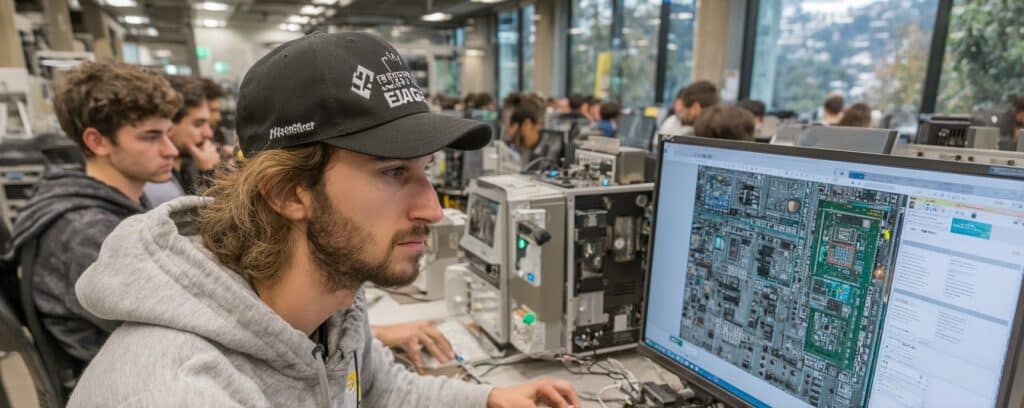
Earning a master’s degree in AI and machine learning online offers a pathway into one of today’s most dynamic and fast-growing fields. For prospective graduate students balancing career, family, or other responsibilities, online study provides meaningful flexibility without sacrificing academic rigor. These programs blend advanced coursework with hands-on technical training, helping students develop the depth of knowledge needed to design intelligent systems, build machine learning models, and contribute to emerging innovations across industries.
What to Expect from an Online Master’s in AI and Machine Learning
Pursuing a master’s degree in AI and machine learning online can offer much of the same academic depth and professional preparation as a traditional on-campus program — but with added flexibility to fit around work, family, or other commitments. Many students enter these programs through one of many available online master’s degree programs, selecting AI or machine learning concentrations to gain cutting-edge expertise without relocating or pausing their careers.
Core Topics Covered
In a typical online AI/ML master’s program, you can expect to take advanced courses in:
- Deep learning and neural networks — foundational methods for pattern recognition, computer vision, speech recognition, and other AI tasks.
- Natural language processing (NLP) — techniques for language understanding, machine translation, sentiment analysis, and conversational AI.
- Statistical machine learning — methods like regression, classification, clustering, reinforcement learning, and probabilistic modeling.
- Ethics, fairness, and governance in AI — as AI systems become more integrated into societal and business decisions, many programs include training on bias, accountability, and responsible AI practices.
- Data engineering and pipeline design — data preprocessing, storage, cleaning, and scalability considerations to support large-scale AI applications.
- Capstone projects or applied research — many programs culminate in a real-world project, enabling students to apply learned skills to build ML pipelines or design AI-driven solutions.
Online Delivery Formats
Online master’s in AI and machine learning programs come in several formats to accommodate different learning styles and life situations:
- Asynchronous: Pre-recorded lectures, readings, and assignments that you complete on your own schedule. Ideal if you need maximum flexibility or are balancing work or family obligations.
- Synchronous: Live virtual classes and discussions scheduled at set times. This format often offers more interaction, real-time feedback, and a more structured pace — useful for those who thrive with routine or teamwork.
- Hybrid: A blend of asynchronous and synchronous elements. For example, lectures might be recorded while seminars or project meetings occur live. This balances flexibility with interaction and community feel.
Flexibility and Technology Platforms
Most online AI/ML master’s programs are delivered through robust learning platforms that support video lectures, collaborative labs, forums, peer review, and real-time coding environments. Expect to work with tools such as Jupyter notebooks, cloud-based GPU instances, sandboxed coding environments, version control (e.g., Git), and sometimes virtual labs that simulate real-world data science infrastructure.
Because of the asynchronous or hybrid nature, students often have the flexibility to log in and work during evenings or weekends, making these programs particularly appealing for working professionals, caregivers, or those transitioning careers. At the same time, many programs build in structured support — teaching assistants, virtual office hours, peer groups, and mentorship — so you’re not studying in isolation.
This blend of rigorous core content, flexible delivery formats, and modern technology platforms helps ensure that an online master’s in AI and machine learning provides both the depth and adaptability that today’s graduate students value.
Top Online Master’s Programs in Artificial Intelligence and Machine Learning
The following programs represent some of the best online master’s degree options in artificial intelligence and machine learning currently available. This list was developed based on several key factors, including program focus and standout features, academic reputation at both the program and institutional level (including graduation rates), and diversity—both in terms of program offerings and geographic representation.
While these programs offer strong starting points for students interested in advancing their careers through AI- and ML-focused graduate study, they are by no means the only options. The best program for any individual student will always depend on that student’s unique goals, background, and circumstances. We encourage readers to explore each program further—both those listed here and others—to find the option that best fits their needs.
Duke University
Master of Engineering in Artificial Intelligence for Product Innovation
Program Overview
Duke University’s Master of Engineering in Artificial Intelligence for Product Innovation is a 30-credit graduate program that focuses on the practical application of AI and machine learning in product development. Designed for students with backgrounds in computer science, engineering, or related fields, the program combines eight technical courses with two business courses and a hands-on capstone project. Students can complete the degree on campus in 2–4 semesters or online over 24 months part-time. The curriculum is structured to equip graduates with both the technical and leadership skills needed to build real-world AI solutions across industries.
George Washington University
Online Master of Engineering in Artificial Intelligence and Machine Learning
Program Overview
The George Washington University offers a fully online Master of Engineering in Artificial Intelligence and Machine Learning designed for professionals seeking to deepen their expertise in AI-driven technologies. The 30-credit program consists of ten three-credit courses and covers a wide range of topics, including neural networks, natural language processing, computer vision, robotics, deep reinforcement learning, and ethical considerations in AI. Courses are delivered through a flexible mix of synchronous and asynchronous formats to accommodate working adults. The program emphasizes both the mathematical foundations and real-world applications of AI and machine learning, preparing graduates for roles in technology, healthcare, finance, transportation, and further academic study.
Georgia Institute of Technology
Online Master of Science in Computer Science (OMSCS), AI Specialization
Program Overview
Georgia Tech’s Online Master of Science in Computer Science (OMSCS) offers a specialization in Artificial Intelligence, providing a flexible and accessible path for professionals to deepen their expertise in both AI and machine learning. The AI specialization consists of 15 credit hours, including core courses such as Artificial Intelligence, Knowledge-Based AI, and Machine Learning, along with electives in areas like computer vision, deep learning, natural language processing, human-computer interaction, and AI ethics. The full OMSCS degree requires 30 credit hours and allows students to complete the program entirely online, with a broad selection of free electives to tailor the experience. Designed for working adults, the program balances academic rigor with real-world application and is part of Georgia Tech’s broader commitment to advancing AI education through interdisciplinary research and global accessibility.
Johns Hopkins University
Master of Science in Artificial Intelligence
Program Overview
Johns Hopkins University offers an online Master of Science in Artificial Intelligence through its Engineering for Professionals division, designed for engineers and technical professionals seeking to advance in AI and machine learning. Developed in collaboration with the Johns Hopkins Applied Physics Lab, the program features a curriculum that blends theoretical foundations with practical applications across topics like robotics, natural language processing, image processing, and expert systems. Students can tailor their coursework to align with their interests and professional goals, and all classes are taught by active researchers and practitioners in the field. The fully online format provides flexibility for working professionals, and the program also emphasizes the ethical and societal dimensions of AI technologies.
Northeastern University
Master of Professional Studies in Applied Machine Intelligence – Online
Program Overview
Northeastern University’s Master of Professional Studies in Applied Artificial Intelligence is a fully online program designed for students from a range of academic and professional backgrounds. The curriculum emphasizes both AI and machine learning, focusing on practical implementation, ethical considerations, and interdisciplinary collaboration. Students can complete the program in 12 to 20 months, full- or part-time, and choose from concentrations such as Conversational AI, AI for 3D Imaging, and Machine Learning for Cybersecurity. With a tuition estimate of $30,500, the program aims to equip graduates with the technical and leadership skills to apply AI across industries including healthcare, cybersecurity, and user experience design.
Stanford University
MS, Computer Science, Artificial Intelligence Specialization
Program Overview
Stanford University’s Master of Science in Computer Science program offers a specialization in Artificial Intelligence, providing a rigorous academic path for students interested in foundational and applied areas of AI and machine learning. The AI specialization includes courses in topics such as logical reasoning, probabilistic modeling, robotics, machine learning, and natural language processing, with options like AI Principles & Techniques, Natural Language Processing with Deep Learning, and Machine Learning. The program is available on campus, though select specializations—including AI—can also be completed online through the Honors Cooperative Program for students residing in the U.S. This structure allows flexibility while maintaining Stanford’s high academic standards, supporting students aiming for technical roles or research careers at the forefront of AI innovation.
Stevens Institute of Technology
Applied Artificial Intelligence Master’s Program
Program Overview
The Master’s in Applied Artificial Intelligence at Stevens Institute of Technology is offered both on campus and fully online, with options to pursue the degree as a Master of Engineering, Master of Science, or a dual-degree MBA. The program emphasizes the development of both theoretical foundations and practical skills in AI and deep learning, with applications across engineering domains. Students engage in hands-on learning that spans machine learning, computer vision, autonomous robotics, smart health, cybersecurity, and intelligent communication systems. The curriculum also includes concentrations in areas such as Biomedical Engineering, Software Engineering, and Systems Biology, allowing students to tailor their education to specific industries. Designed for flexibility and career alignment, the program prepares graduates for roles like AI engineer, machine learning engineer, and data scientist.
Tulane University
Online Master of Science in Computer Science (MSCS)
Program Overview
Tulane University’s Online Master of Science in Computer Science offers a flexible, fully online format for students seeking advanced technical training with the freedom to specialize. Among the six available focus areas is Artificial Intelligence and Machine Learning, alongside others like data science and computational biology. The program emphasizes applied technology and real-world relevance, with faculty expertise spanning areas such as computational geometry and AI-driven healthcare solutions. Designed for working professionals, the MSCS can be completed at your own pace, with cohort start dates available in the fall, spring, and summer.
University of Maryland
Engineering Artificial Intelligence MS
Program Overview
The University of Maryland’s Master of Engineering in Engineering Artificial Intelligence offers a flexible, technically focused graduate program that blends AI and machine learning with applications in engineered systems. Delivered both on campus and online through the Maryland Applied Graduate Engineering (MAGE) unit, the 30-credit program includes core coursework in AI fundamentals and electives in areas such as generative AI, robotic intelligence, deep learning, and large language models. Students can further specialize through electives that align with engineering subfields like embedded systems, biomedical engineering, cloud computing, and systems engineering. Designed for professionals with STEM backgrounds, the program emphasizes practical, interdisciplinary applications of AI in domains like industrial systems, communications, medical signal processing, and cybersecurity.
University of North Carolina at Chapel Hill
Master of Applied Data Science
Program Overview
The University of North Carolina at Chapel Hill offers a Master of Applied Data Science (MADS) through its School of Data Science and Society, with a curriculum that integrates AI and machine learning alongside broader data science topics. This 16-month, full-time online program emphasizes practical application, ethical considerations, and interdisciplinary collaboration. Students complete 10 courses (30 credits), including instruction in machine learning, deep learning, AI ethics, statistical modeling, and advanced programming, culminating in a team-based capstone project. Designed for professionals with foundational knowledge in programming, statistics, and linear algebra, the MADS program prepares graduates to tackle real-world challenges in data-driven roles across sectors such as healthcare, government, finance, and technology.
University of San Diego
Online Master of Science in Applied Artificial Intelligence
Program Overview
The Master of Science in Applied Artificial Intelligence at the University of San Diego is a fully online, 30-unit program designed to be completed in 20 months. The curriculum focuses on real-world applications of AI, with emphasis on machine learning, deep learning, AI ethics, and socially responsible system design. Students take one course at a time in seven-week blocks and complete a final capstone project that showcases their ability to solve real-world problems using AI. The program is particularly suited for professionals from STEM and non-STEM backgrounds who are looking to transition into AI roles or expand their technical expertise. With three start dates per year and a flexible online format, the program is structured to meet the needs of working professionals across a variety of industries.
University of Washington
Master of Science in Artificial Intelligence and Machine Learning for Engineering
Program Overview
The University of Washington’s Master of Science in Artificial Intelligence and Machine Learning for Engineering is a flexible, stackable degree program designed specifically for working engineers. Offered fully online or on campus, the part-time format enables professionals to develop advanced AI and ML skills and apply them directly to engineering domains such as manufacturing, robotics, and chemical processes. The program structure includes two graduate certificates and a capstone project, with content focused on domain-specific applications, mathematical foundations, and ethical use of AI tools. Students build both theoretical knowledge and practical skills to implement, evaluate, and adapt AI/ML methods in engineering contexts.
Vanderbilt University
Computer Science Graduate Degree Program
Program Overview
Vanderbilt University offers a Master of Science in Computer Science, available in both online and on-campus formats, with opportunities to focus on areas related to artificial intelligence and machine learning. The program supports both thesis and non-thesis options and allows students to explore a wide range of research areas, including intelligent systems, robotics, trustworthy computing, and image processing. While not a standalone AI degree, the program integrates AI/ML through interdisciplinary research and courses aligned with the School of Engineering’s strategic directions, including healthcare, security, and smart systems. Students benefit from access to state-of-the-art computational facilities and collaborative faculty expertise across technical domains.
Wake Forest University
Master of AI Strategy and Innovation
Program Overview
Wake Forest University’s Master of AI Strategy and Innovation is a fully online, interdisciplinary graduate program that emphasizes the ethical and strategic use of artificial intelligence across industries. Designed for working professionals, the program spans 10 courses over approximately two years and blends technical instruction—such as machine learning applications and emerging AI tools—with coursework in leadership, cross-functional collaboration, and responsible innovation. The curriculum culminates in a capstone project focused on real-world AI implementation. Rooted in Wake Forest’s human-centered mission, the program prepares graduates to lead AI initiatives in sectors like healthcare, finance, public policy, and technology.
Worcester Polytechnic Institute
Master of Science in Artificial Intelligence
Worcester Polytechnic Institute (WPI) offers a Master of Science in Artificial Intelligence, available both online and on campus, with a flexible, interdisciplinary curriculum grounded in real-world application. The 30-credit program includes core courses in AI, machine learning, ethics, knowledge representation, and human-AI interaction. Students can choose between a team-based capstone project or a research-focused thesis, and further tailor their studies with one of thirteen specializations, such as AI & Health, AI & Security, or AI & Robotics. Emphasizing responsible innovation, the program prepares students to develop and deploy AI systems across sectors while collaborating with faculty and industry partners on applied projects.
Benefits of Earning a Master’s in AI and Machine Learning Online
Advancing your education through a master’s degree in AI and machine learning online can offer a range of professional and personal benefits. These programs are designed to equip students with specialized technical skills while providing the kind of flexibility that supports busy schedules and evolving career goals.
Career Mobility and Access to Leadership Roles
Graduates often qualify for higher-level positions that require advanced expertise in machine learning, predictive modeling, and intelligent system design. Employers across the tech sector and beyond increasingly look for candidates who can lead projects, manage data-driven initiatives, and guide AI strategy — responsibilities that typically require graduate-level training.
In-Demand Skills Across Sectors
AI and machine learning are transforming multiple industries, including:
- Technology, through automation, software optimization, and large-scale data analysis
- Healthcare, with innovations in diagnostics, imaging, and personalized medicine
- Finance, through algorithmic trading, fraud detection, and risk modeling
- Manufacturing, via robotics and predictive maintenance
- Education, through adaptive learning and assessment technologies
Because these skills are relevant across industries, graduates gain versatility and resilience in an evolving job market.
Flexibility for Working Professionals and Caregivers
One of the most significant strengths of pursuing a master’s degree in AI and machine learning online is the ability to balance academic growth with real-life commitments. Asynchronous and hybrid formats allow students to progress at a pace that fits their work schedules, caregiving responsibilities, or geographic constraints. This flexibility often enables career changers and mid-career professionals to deepen their expertise without interrupting employment.
Enhanced Competitiveness and Expanded Networks
Many online programs connect students with faculty mentors, cohort peers, alumni groups, and industry partners. These networks can open doors to internships, research opportunities, and job placements. Combined with advanced technical training, this access helps graduates stand out in a competitive hiring landscape.
By pursuing a master’s degree in AI and machine learning online, students gain both the specialized skills needed for high-impact roles and the flexibility to shape their education around their personal and professional goals.
Tips for Finding the Right Online Program
Choosing the right master’s degree in AI and machine learning online requires careful comparison of programs, curricula, and support services. Because these degrees represent a significant investment of time and resources, it’s important to assess how well each option aligns with your long-term career goals and learning preferences.
Align Specialization Options with Your Long-Term Goals
Programs may offer different focus areas — such as deep learning, robotics, natural language processing, computer vision, or data engineering. Look for options that match the type of work you ultimately want to pursue. For example, students interested in autonomous systems may prioritize robotics-heavy coursework, while those focused on enterprise AI might prefer programs emphasizing machine learning operations (MLOps) and deployment.
Check Accreditation and Industry Partnerships
Institutional accreditation ensures your degree meets recognized academic standards. Beyond that, some programs collaborate with tech companies, research labs, and cloud providers to offer hands-on projects or access to proprietary tools. When choosing a master’s degree in AI and machine learning online, look for programs that integrate real-world datasets, cloud-based environments, and industry-informed curriculum updates.
Compare Tuition, Financial Aid, and Cost-per-Credit
Tuition structures vary widely among online programs. Review cost-per-credit, estimated total tuition, and any additional fees for technology, campus visits, software licenses, or proctored exams. Exploring financial aid options, tuition discounts, and employer reimbursement programs can also help make graduate study more affordable.
Evaluate Career Services and Alumni Outcomes
Strong career support can make a significant difference post-graduation. Look for programs that provide:
- Resume reviews and interview prep
- Internship placement support
- Networking opportunities with alumni
- Access to job boards or employer partnerships
Checking alumni career paths can also help you understand the types of roles graduates secure and whether the program has a track record of helping students advance into AI and machine learning positions.
By taking a structured and informed approach, you can identify the online program that best supports your aspirations and helps you build the skills needed for today’s rapidly evolving AI landscape.
Job Roles and Career Outlook
Graduates of a master’s degree in AI and machine learning online can pursue a wide range of advanced technical and strategic roles. Because AI continues to expand across industries, professionals with graduate-level training are increasingly sought after for their ability to design, evaluate, and deploy intelligent systems at scale.
Common Job Roles
Many graduates move into roles such as:
- AI Engineer — building intelligent applications, optimizing algorithms, and integrating AI systems into production environments
- Machine Learning Scientist — researching new modeling techniques, developing prototypes, and advancing the state of the art in supervised and unsupervised learning
- Data Scientist or Senior Data Scientist — analyzing complex datasets, creating predictive models, and guiding data-driven organizational decisions
- Data Architect — designing data pipelines and architectures that support large-scale machine learning and analytics
- Computer Vision Engineer — developing image- and video-based recognition systems
- Natural Language Processing (NLP) Engineer — creating conversational AI systems, text classifiers, summarization tools, and language models
- AI Product Manager — aligning AI capabilities with user needs, product goals, and business strategy
Employment Projections and Salary Outlook
The demand for AI and machine learning expertise continues to grow, and many associated roles show strong long-term career potential. For example, the U.S. Bureau of Labor Statistics (BLS) reports that employment for computer and information research scientists, a category that includes many AI and machine learning specialists, is projected to grow much faster than average over the next decade. According to the U.S. Bureau of Labor Statistics (BLS), the median annual wage for these professionals was among the highest in the technology sector.
While some AI-specific titles (such as AI engineer or machine learning engineer) do not yet have their own BLS classifications, they often align with roles included in data science, research computing, or advanced software development categories — all of which show strong economic outlooks.
Growing Demand Across Industries
AI adoption continues to accelerate across multiple sectors, driving demand for specialized talent:
- Cybersecurity: threat detection, anomaly identification, and real-time response systems
- Robotics: autonomous systems, navigation algorithms, and sensor fusion
- Healthcare: diagnostic modeling, medical imaging analysis, and clinical decision support tools
- Finance: fraud detection, risk modeling, and high-frequency trading
- EdTech: adaptive learning systems, analytics, and automated assessment tools
With AI becoming integral to organizational strategy and innovation, graduates with advanced technical training are well positioned for long-term career advancement and competitive earning potential.
FAQ: Online Master’s Degrees in AI and Machine Learning
Do I Need a Tech Background to Apply?
Many programs prefer applicants with experience in computer science, engineering, mathematics, or related fields. However, some online master’s degree programs offer foundational courses to help students strengthen skills in programming, statistics, or linear algebra before beginning advanced AI and machine learning coursework. Requirements vary, so it’s important to review prerequisites for each program.
How Long Is the Typical Program?
Most online programs take 18–24 months to complete when pursued full time. Part-time options may extend the timeline to two to three years, offering additional flexibility for working professionals or caregivers.
Are Online Degrees Respected by Employers?
Yes. Accredited universities deliver many of today’s online AI and machine learning programs, and employers increasingly recognize the rigor and industry relevance of these degrees. Because coursework, capstone projects, and technical skill-building are often identical to on-campus offerings, graduates receive preparation that aligns with real-world workforce expectations.
Can I Specialize Within the Program?
Many master’s degree in AI and machine learning online pathways offer concentration options such as:
- Natural language processing
- Computer vision
- Robotics or autonomous systems
- MLOps and scalable deployment
- Data science or advanced analytics
Specializations help students tailor their studies to career interests, research goals, or emerging areas of industry demand.
Finding the Best Fit for Your Goals
Identifying the right master’s degree in AI and machine learning online begins with understanding how your academic strengths, professional goals, and personal circumstances intersect. Because these programs vary in focus, delivery, and support structures, taking time to evaluate each option can help you make a confident and informed decision.
Align Academic Strengths with Professional Needs
Reflect on the technical skills you already possess and the areas you want to develop. Students with strong math or programming backgrounds may gravitate toward research-heavy programs, while those aiming for applied industry roles might prefer curricula centered on deployment, product integration, or real-world project experience.
Consider Networking, Mentorship, and Flexibility
While online study offers convenience, strong community support is still essential. Look for programs that provide access to faculty mentors, peer collaboration, and alumni engagement opportunities. Flexible scheduling options — such as asynchronous lectures or part-time pathways — can make it easier to balance coursework with work and family responsibilities.
Encourage Proactive Research and Engagement
Before applying, explore each program’s structure, course descriptions, faculty expertise, and available resources. Attending virtual events, speaking with admissions counselors, or reviewing sample projects can offer insight into the student experience and help confirm whether the program aligns with your goals.
A master’s degree in AI and machine learning online can open doors to innovation-driven careers, but the best fit is the one that empowers you to grow, specialize, and confidently enter a field where opportunities continue to expand.